Chemical Anchor vs Mechanical Anchor: Which One Should You Choose?
Introduction
In modern construction and industrial applications, selecting the right anchoring system is essential for safety, durability, and long-term structural performance. Among the most widely used fastening solutions are Chemical Anchors and Mechanical Anchors.
Both anchoring systems are designed for fixing heavy loads into concrete, brickwork, and masonry surfaces, but their working methods, applications, and performance differ significantly.
In this guide, we explain the difference between chemical anchors and mechanical anchors, their advantages, applications, and how to choose the best anchoring solution for your project.
What is a Chemical Anchor?
A Chemical Anchor is a high-performance anchoring system that uses chemical adhesive resin to bond threaded rods, rebars, or anchor studs into concrete or masonry.
Chemical anchors are commonly used in heavy-duty construction projects where high load capacity and long-term reliability are required.
Popular brands include Fischer Chemical Anchors and Hilti Chemical Anchors.
How Chemical Anchors Work ?
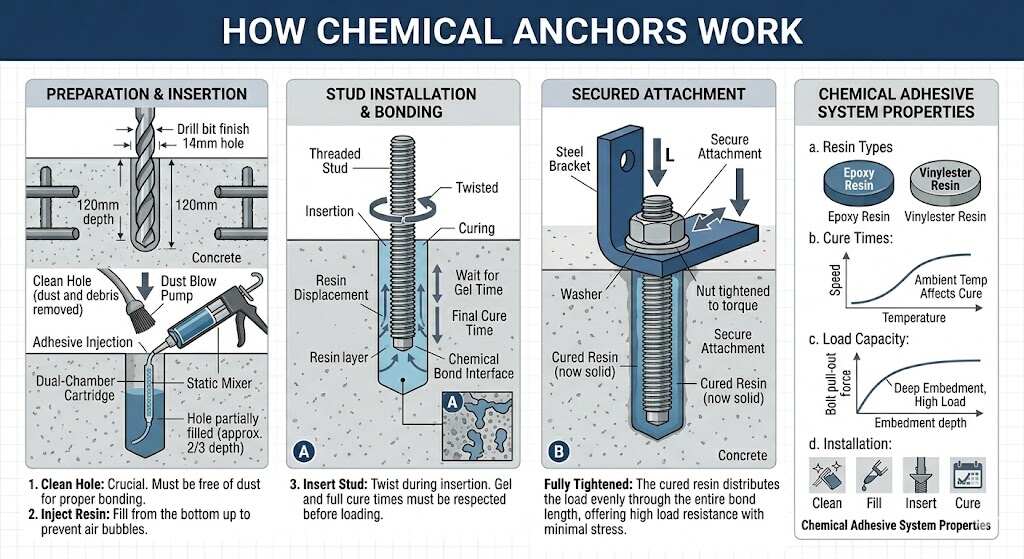
- Drill a hole into the concrete or base material
- Clean the hole thoroughly using a brush and blower
- Inject chemical resin or injection mortar
- Insert threaded rod or rebar
- Allow proper curing time
Once cured, the resin creates a strong bond between the anchor and the base material, providing excellent holding strength.
Advantages of Chemical Anchors
- High load-bearing capacity
- No expansion stress on concrete
- Ideal for edge fixing applications
- Suitable for cracked concrete and hollow blocks
- Excellent vibration resistance
- Corrosion-resistant options available
- Long-lasting and durable performance
Common Applications of Chemical Anchors
- Structural steel connections
- Heavy machinery installation
- Rebar doweling works
- Facade and cladding systems
- Industrial equipment fixing
- Bridge and infrastructure projects
What is a Mechanical Anchor?
A Mechanical Anchor is a fastening system that works through expansion force. When the anchor bolt is tightened, it expands inside the concrete and creates a secure grip against the base material.
Mechanical anchors are widely used for fast and economical fixing applications.
Common Types of Mechanical Anchors
- Wedge Anchors
- Sleeve Anchors
- Drop-In Anchors
- Through Bolt Anchors
How Mechanical Anchors Work ?
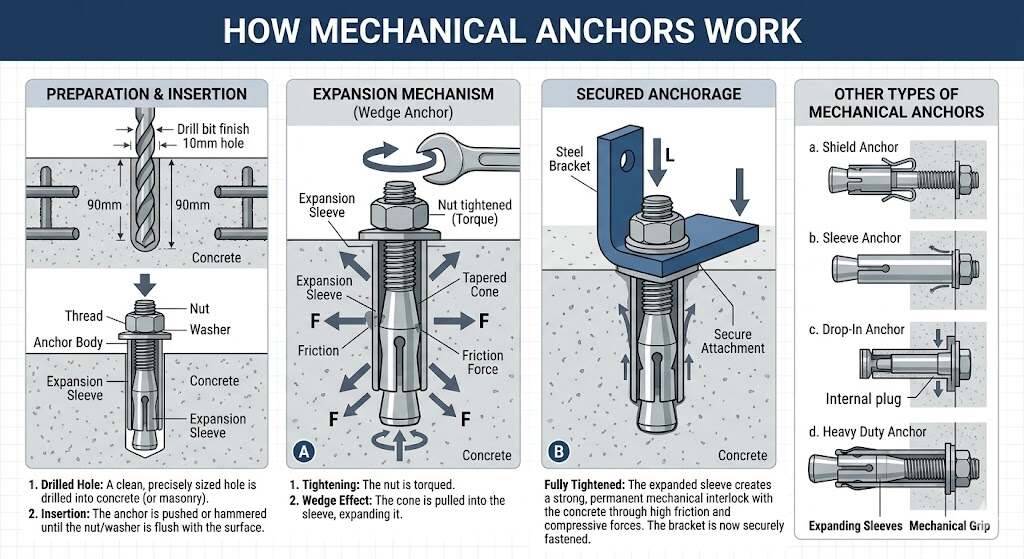
- Drill a hole into concrete
- Insert the mechanical anchor
- Tighten the nut or bolt
- The anchor expands and locks into the concrete
Advantages of Mechanical Anchors
- Fast and easy installation
- No curing time required
- Cost-effective solution
- Easy inspection after installation
- Suitable for light to medium load applications
Common Applications of Mechanical Anchors
- Handrails and railings
- Cable tray installation
- HVAC support systems
- Pipe supports
- Light structural connections
- Industrial brackets and supports
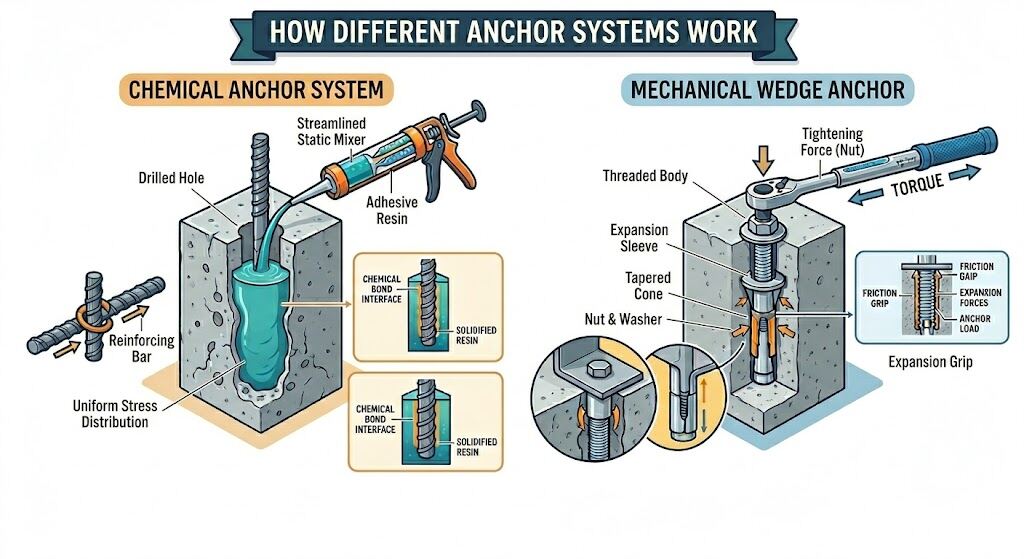
Chemical Anchor vs Mechanical Anchor
| Feature | Chemical Anchor | Mechanical Anchor |
|---|---|---|
| Load Capacity | Very High | Medium to High |
| Installation Time | Slower (Curing Required) | Fast Installation |
| Expansion Stress | No | Yes |
| Edge Distance Suitability | Excellent | Limited |
| Vibration Resistance | Excellent | Moderate |
| Cost | Higher | Economical |
| Cracked Concrete Performance | Excellent | Moderate |
When Should You Choose Chemical Anchors?
Chemical anchors are recommended when:
- Heavy load performance is required
- Installation is near concrete edges
- Base material is cracked or weak
- Long-term structural durability is important
- Vibration resistance is necessary
Chemical anchoring systems are widely preferred in industrial, commercial, and infrastructure projects.
When Should You Choose Mechanical Anchors?
Mechanical anchors are ideal when:
- Fast installation is required
- Load requirements are moderate
- Budget-friendly fixing solutions are needed
- Temporary or standard fixing applications are involved
Mechanical anchors are commonly used in routine construction and maintenance projects.
Expert Recommendation
For critical structural and heavy-duty applications, Chemical Anchors generally provide stronger bonding strength, higher safety, and better long-term performance.
However, Mechanical Anchors remain an excellent choice for quick, economical, and medium-load installations.
At Ram Nath Sons, we supply premium quality Chemical Anchors, Mechanical Anchors, Injection Mortars, Frame Fixings, and Industrial Fastening Solutions from trusted brands like Fischer, Hilti, and JNM.
Our team helps contractors, engineers, builders, and industrial clients choose the right anchoring system based on project requirements.
Conclusion
Both Chemical Anchors and Mechanical Anchors play an important role in modern construction and industrial fastening applications. The right selection depends on load requirements, installation conditions, project budget, and long-term performance expectations.
Using the correct anchoring system improves structural safety, installation reliability, and overall project durability.